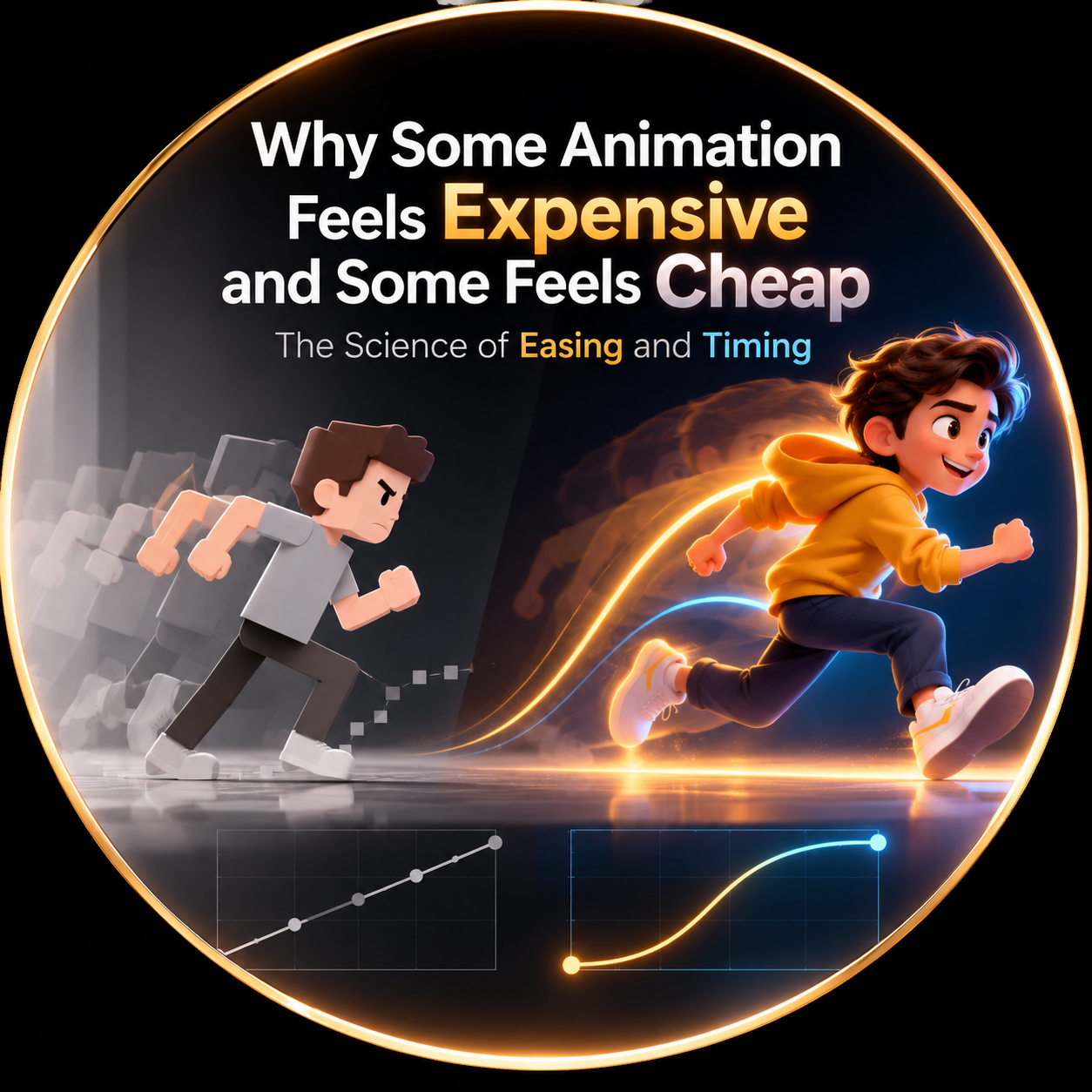
Have you ever watched two animated videos with similar graphics but noticed that one feels premium while the other looks unprofessional? The difference often isn’t the illustration quality, software, or visual effects. It’s something more subtle: easing and timing in animation.
These two fundamental principles determine how objects move, how characters behave, and how naturally an animation communicates its message. Understanding them is essential for creating professional animation, motion graphics, and high-quality explainer videos.
What Is Easing in Animation?
Easing refers to how an object’s speed changes during movement. In real life, objects rarely start and stop instantly. A car accelerates gradually, a ball slows as it reaches its highest point, and a person naturally changes speed while walking.
Animation follows similar principles.
Linear animation maintains a constant speed throughout a movement, often making objects appear robotic or mechanical.
Ease-in animation starts slowly and gradually accelerates.
Ease-out animation begins quickly and slows down before stopping.
Ease-in-out animation combines gradual acceleration and deceleration, creating smooth, natural movement.
Professional animators use these techniques to make transitions more believable and visually appealing.
Why Timing Makes Animation Feel Premium
Timing determines how long an action takes and when it happens. Even beautifully designed graphics can appear cheap when their movements are poorly timed.
For example, imagine a logo appearing on screen. If it moves too quickly, viewers may struggle to recognize it. If it moves too slowly, the animation can feel boring.
The right timing creates balance between visual engagement and clarity.
In 2D animation, character animation, and SaaS explainer videos, timing also controls storytelling. A brief pause before revealing an important feature builds anticipation, while faster transitions can communicate energy and excitement.
Effective timing ensures that viewers understand the message without feeling overwhelmed.
The Role of Motion Curves and Spacing
Professional motion designers use animation graphs, commonly called speed graphs or value graphs, to control movement precisely.
These curves determine how an object’s position, scale, rotation, or opacity changes over time.
Smooth curves typically create polished transitions, while abrupt changes can make movement appear unnatural.
Spacing is equally important. The distance an object travels between frames determines its perceived speed.
Small spacing creates slower movement, while larger spacing produces faster movement.
Combining thoughtful spacing with carefully adjusted motion curves creates the fluid motion associated with premium motion graphics and professional video animation.
How Easing and Timing Improve Brand Perception
Animation quality directly influences how audiences perceive a business.
Smooth, intentional movement can communicate professionalism, reliability, and attention to detail. Poorly executed transitions may make even a well-designed brand appear less credible.
For businesses investing in animated explainer videos, product demonstrations, or digital marketing animations, these details matter.
Premium animation doesn’t necessarily require complex visuals. It requires purposeful movement that supports the story and guides the viewer’s attention.
Final Thoughts
The difference between cheap-looking and premium animation often comes down to how thoughtfully movement is designed.
Easing creates natural motion. Timing creates rhythm. Together, they create visual experiences that feel polished, engaging, and memorable.
At SpaceX Animation, we believe exceptional animation isn’t simply about moving graphics. It’s about making every movement meaningful, helping brands communicate complex ideas with clarity, creativity, and confidence.